
Trace Menifee's Former Owners
Build a timeline with one row per transfer. The newest deed is a starting point, not the whole history. Its grantor usually supplies the next prior owner, and the prior deed reference plus legal description keep the search tied to the same land when names or map IDs change. Log each step as you go.
| Transfer date | Grantor → grantee | Instrument | Reference |
|---|---|---|---|
| Newest located | Prior owner → latest grantee | Warranty, quitclaim, commissioner or other deed | Book/page or instrument number |
| One step earlier | Earlier owner → prior owner | Acquisition deed | Reference cited by newest deed |
| Parent-tract era | Parent owner → subdivider or successor | Deed plus recorded plat | Plat cabinet/slide or older book/page |
| Estate interval | Decedent/estate → heir or buyer | Affidavit, order or representative's deed | Probate and land-record citations |
Never fill a missing row by assumption. If a deed image is unavailable, mark the break. If an estate document is missing, do the same. Then ask the clerk for the specific book, instrument, or date span.
Menifee Deeds Reach to 1795
The Menifee County Clerk describes courthouse legal records running from 1795 to the present. Most document indexes begin in 1880. Images cover most instrument filings from January 1795 forward. That repeated word "most" matters. It is not a promise that every year or instrument type appears remotely. Remote eCCLIX access takes an account and fees.
Indexes and copies can be inspected free at the clerk's office, 12 Main Street in Frenchburg. Before treating a gap as a missing transfer, ask whether an older entry lives in eCCLIX, a paper index, a deed book, microfilm, or an archive.
Use Menifee's Official Record Route
Every access channel for the historic chain, from remote eCCLIX to free courthouse inspection, appears on the clerk's official records page. Review the Menifee County Clerk records page.
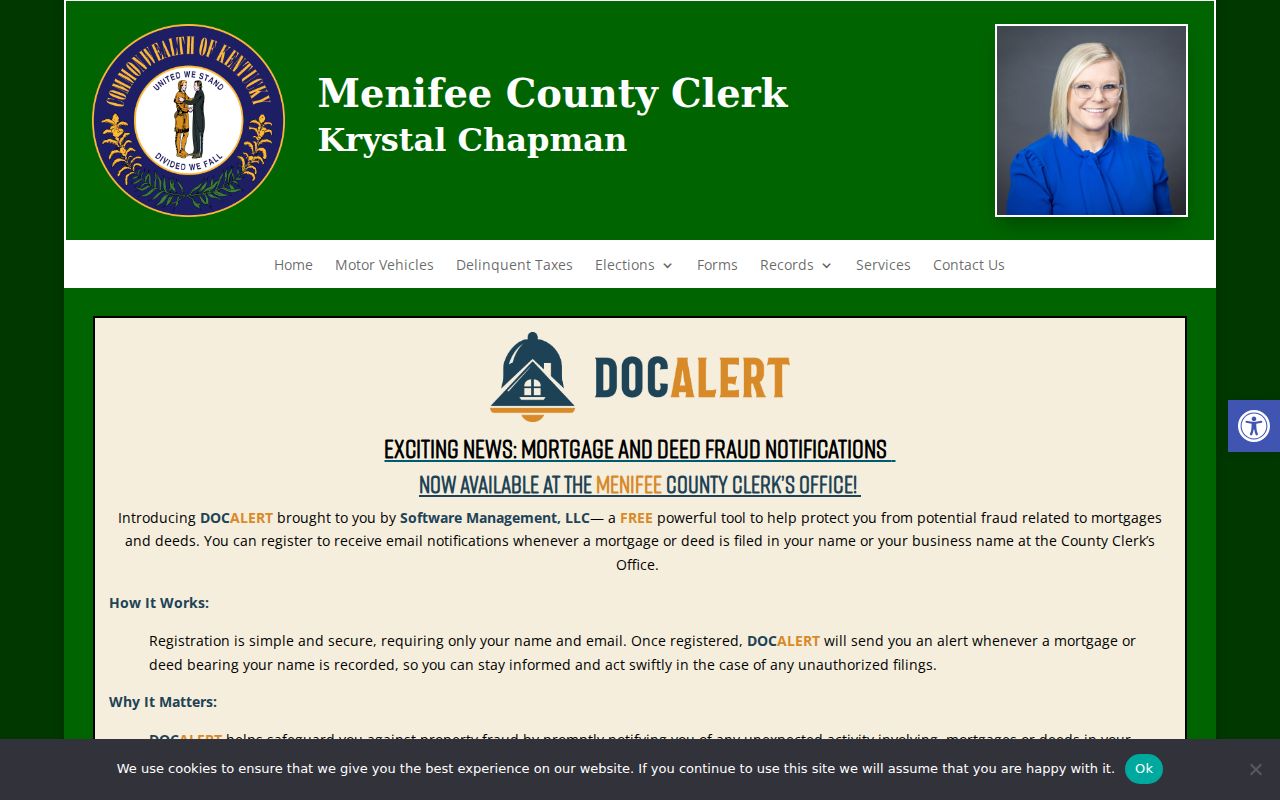
The page backs the county's coverage statement and the eCCLIX route. It does not trace a parcel's full chain. Log spelling variants, instrument categories, and negative searches. That detail, along with the last date you checked, lets another researcher reproduce the work without mistaking a missed index entry for an absent deed.
Reconstruct Menifee's Deed Chain
Each transfer unlocks the one before it. Log every search. Record negative results and the latest recording date you checked, so "latest located" never hardens into an unsupported claim of completeness.
- Locate the newest deed matching the current legal description.
- Record its grantor, grantee, recording date, deed type and prior reference.
- Search the grantor as a grantee during the earlier acquisition period.
- Match acreage, lot, unit, roads, adjoining owners and plat language.
- Repeat into paper indexes or deed books when the remote index is incomplete.
- Grantor
- The party conveying an interest.
- Grantee
- The party receiving the interest.
- Reverse index
- An index organized by grantee, useful for finding how a former owner acquired the land.
- Quitclaim deed
- A conveyance of whatever interest the grantor had, without the assurances of a warranty deed.
Menifee Plats Restore Old Clues
Subdivision vocabulary can outlast street addressing. Menifee public notices preserve leads like Hidden Acres and Woodland Estates Unit 2. They also name Whitts Acres Second Revision and Canyon View Unit 4. One Hidden Acres reference pairs old Plat Book 1 page 67 with modern Plat Cabinet 1 Slide 51. That dual citation can bridge an index change.
Treat these notices as dated leads. They are not certified chains or proof that a named subdivision lies inside incorporated Frenchburg. Use the plat to match lot, unit, roads, easements, and restrictions. Then return to the deeds. For rural land, metes-and-bounds calls and survey references may help more than a subdivision name.
Bridge Menifee Estate Transfers
A decedent's name can vanish from the deed sequence. Search wills, probate orders, affidavits of descent, executor or administrator deeds, distributions, and later conveyances. KDLA's inventory lists Menifee wills from 1870 through 2015. It describes holdings, not guaranteed online images.
Marriage records can explain a surname change. The Menefee Meteor and Frenchburg Reporter collections may reveal a sale or estate notice. These are leads only, and the chain still needs the recorded land instrument or court order tied to the same legal description.
Before Menifee County Formed
Menifee County was formed in 1869. It took land from Bath, Montgomery, Morgan, Powell, and Wolfe counties. That history matters for any chain reaching earlier. A pre-1869 land record may sit in a parent county's books. The clerk describes local holdings back to 1795. Match the legal description.
Waterways, roads, neighbors, and land-patent clues guide the choice of parent jurisdiction. Kentucky Department for Libraries and Archives guides and county inventories can route the search as well. County inventories fill in gaps. Verify every abstract against the original deed book or a copy before relying on it.
Measure Menifee Ownership Depth
The remote stop is not always the real one. eCCLIX is just one channel. Free courthouse inspection extends the reach, and so do other routes. A narrow mailed, faxed, or emailed open-records request can do the same. KDLA inventories, historical judicial indexes, and parent-county material also help as the dates require. The clerk's policy allows five working days to determine an open-records request. Weekends and legal holidays are excluded. That is not a promise of quick fulfillment for a large search.
State the earliest deed actually verified. Name the record series used. Flag every unresolved break. A newspaper notice, old tax roll, or genealogy record can corroborate a time and a name. None of them replaces a recorded conveyance. For present ownership, leave this backward chain and use the Menifee current owner workflow.
Lawful use. Trace former owners for property history, estate work and title diligence. Never use historical records to track, harass or harm a living person.